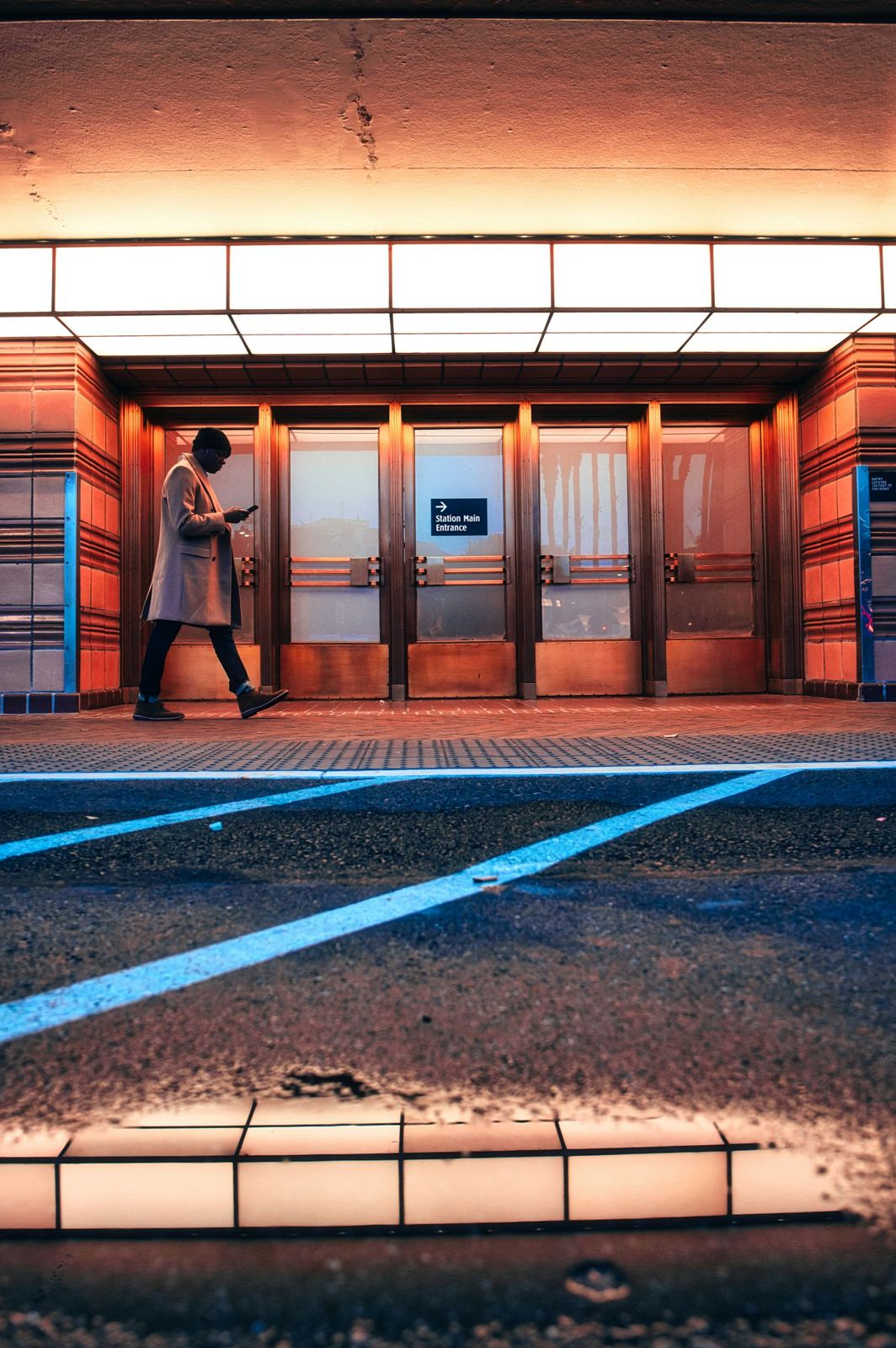
A walk with a camera doesn’t need a deliverable. I like that. When you run an agency, a lot of your day belongs to a brief, a schedule, or a decision someone’s waiting on.
Street photography gives me room to follow something simply because it caught my eye. The street has its own plans. You work with what shows up.
Looking takes a little longer
The first thing you notice is often the easiest thing to photograph. A bright sign, an unusual outfit, a dramatic building. It’s worth staying long enough to see what else the scene is doing.
A person might be almost hidden by a reflection. Two unrelated gestures might briefly line up. The small thing at the edge can become the reason the picture exists.
I’m interested in that change in attention. A place doesn’t have to be spectacular to hold a picture. Sometimes it needs you to stop treating it as the space you pass through on the way somewhere else.
The frame is a choice
There’s always more happening than a photograph can include. Moving a little changes which things touch, which shapes repeat, and whether a person appears separate from the background. The scene can stay the same while the picture becomes completely different.
That’s a useful reminder for any creative work. What you leave in asks for attention. If several things are asking at once, you have to decide whether that tension is doing something worthwhile.
I can admire a busy photograph. I can also admire one with almost nothing in it. The question is whether the choices give me a reason to keep looking.
A person is more than a visual element
Photographing the street also means paying attention to people as people. Someone having a difficult moment is still having that moment after you’ve walked away. A strong composition doesn’t settle the question of whether an image should be made or shared.
I want that consideration to stay part of the practice. Sometimes the right decision is to lower the camera. Sometimes a conversation is more interesting than trying to remain unnoticed.
There’s no need to make a performance out of that judgment. You’re sharing the street with people who have their own lives. The picture is one small part of what’s happening.
Some pictures can stay unresolved
Personal work gives me room for images I can’t explain quickly. A frame might have a strange balance, an awkward detail, or a mood that feels more precise than any caption I could write for it. I want to leave space for that.
A portfolio encourages you to make a clear argument about what you do. An archive can hold things that are still questions. Keeping both feels useful.
The same goes for photographs I choose not to show. Looking through a sequence can tell me what I keep noticing, where I repeat myself, and when an image is relying on a familiar trick. The practice includes that quieter act of editing.
Bringing the attention back
The useful habits travel. Looking at a photograph makes me think about where the eye enters a website. Waiting for a gesture makes me think about how long an edit should hold before moving on.
Those connections are interesting because they happen across different kinds of work. A rhythm can exist in a sequence of images or in the spacing between sections on a page. A small interruption can make either one feel more alive.
I also want the photography to have a life of its own. A personal picture can be worth making without becoming a lesson for a client project. Some days, noticing something and keeping a record of it’s enough.
Running an agency means thinking ahead. A walk with a camera brings me back to what’s in front of me. Some of those pictures will live here.
All six notes ↗